The center of gravity in my work is the question of blackness, and the complexity held within the experience which it names: resistance, virtuosity, flexibility, breaking, hypermobility, and inordinate constraint, all stemming from the apocalyptic experience of having the world literally turned upside down through transatlantic slavery and its relentless reverberations.
The idea of my work in this context takes on terrible weight, especially given the role of black women in performing multiple modes of forced labor–reproductive, agricultural, domestic, affective. This fundamental assault on the flesh, this pained brokenness, haunts my body and all of its labors. With my diagnosis of rheumatoid arthritis in 2015, (the symptoms having been initially noticed while performing a routine domestic task), these concerns have reached a pitch of visceral intensity. My creativity allows me to re-imagine a pick breaking a lock to open a space within the no-space of pain. I continue to work and live with this new set of tools to trace motion and memory.
In my practice, all these things move by way of memory and gesture.
For me, gestures are a way into the histories and cultures of a people; they recall both movement and geographies held in the body. The violent arrest of bodies, their captivity within structures of domination, all animate the process.
This movement rejects seamlessness; it doesn’t conceal these fissures and ruptures, but plays them out as knowledge. I accumulate and layer diasporic gestures while peeling away at the concept of “form”: jagged breaks, shakes, and jigs enact a making and breaking of form simultaneously. This unruly movement wrings the body of all its expressive capacities and builds up something else: new scores of space, alternate routes of escape and feeling.
As an artist for 40 years I have always woven together community-specific performance and experimental forms rooted in sharing embodied knowledge across a multitude of sites, communities, and histories. I have sought to share this movement with generations of others–labors undertaken despite the exclusions from the dance world as a mothering black artist.
How I work is two-fold: the work gets made under the audience/viewer’s gaze and with the secret charge I give myself to open a vortex unbeknownst to me in the beginning of the making. During the act of making movement I am always pushing through the ‘made-up’ story until it becomes real. I want you – the people – around when I’m working; that’s when I really go somewhere, when someone witnesses: an audience of strangers, my children, the children of strangers. Like the flock of children who ran with me, like little rabbits, after I climbed down the side of a castle at Snug Harbor and fled through the field. They ran with me like I was theirs! They were mine.
I am a third generation artist–streaming through my patrilineal great-grandmother, a tea leaf reader and soothsayer, to my matrilineal grandmother, the first African-American artist to sign an extended contract with MGM Pictures, to my late father, artist, sculptor, educator. I come in on that beam, on that oceanic-cybernetic past/futurity matrix. I hold inside of me this push, this pull, this mark that makes the mark, makes the dance that whirls in and out of worlds resisting the formulation of a question. I am fixated on a way to tear a hole in the floor of a covered boat, my body hitting the water’s surface going down past the ocean floor to the other(side) that lands me into sides that are not othered.
My work is rooted in the power and rigors of practice, and the turning of performance towards an articulation of agency. Agency is a serious matter for the descendants of slaves. These are maneuvers or tactics that we enact everyday under conditions of unfreedom. This is the context of black performance. I move from the dual operations of queering space and resisting conformity as these are embedded in black (social) dance – towards something else.
The African diaspora is both a resource and a method of social and aesthetic making.
Moving embodied scholarship forward through this dancing body has always been and continues to be a catalyst for social change and transcultural healing practices, by way of tending to ancestral memories.
Remembering our flesh which is woven in a thick fabric of quotidian trauma, black women have been fighting for something else for centuries, in schools, in courts, in kitchens, in alleyways, in parlors, offices, behind brooms, mops, and typewriters, in the streets, intuitively, ALL THE TIME, and yet there is no one special way to work. The black female body is not docile or apologetic. Our fugitivity implies a refusal to be captured; this refusal is also an insistence on living fully in a world where violence becomes imminent at almost every turn.
My dancing lives interstitially in a space that is elsewhere, a sublime and vaporous place.
In my examination of new paradigms surrounding the dancing body–its constructs and contexts, its embodied geography, linguistics, atmospheric and oceanic properties–I am turning it into something else.
My context is crafting for the stage and elsewhere/everywhere, in spaces such as galleries, museums, city gardens, river ports, shrines, churches, mosques, slave castles, East and West African farms, and historical architectural sites (both abandoned and cherished). These places infuse my work with a constant, unresolved dialectic between the site and the gesture.
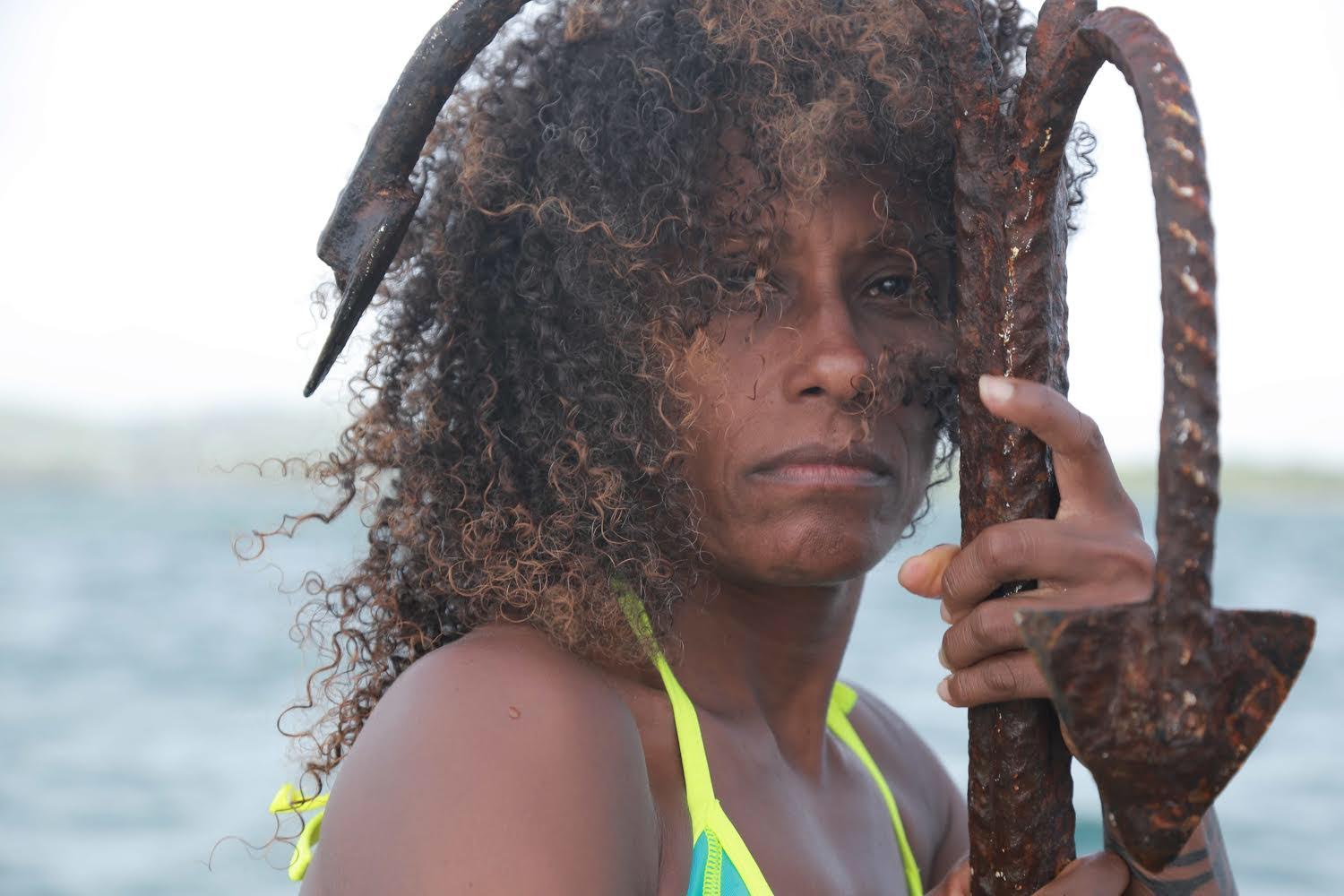
My most recent project titled g1(host):lostatsea – an unfolding of the term “ghost”– pursues questions regarding my body's status as it pivots on this fundamental query: what remains of the Middle Passage as force, gesture, and affect? In 2018 I gained my deep-sea diving certification to further my research, which radically rearranged my sensorium and my movement schema and enabled me to film underwater dives in California and the Caribbean.
These arduous descents trace the ghostly energies of an oceanic archive and are entangled with the excavation of my own memories, from childhood revelry in my grandparent’s backyard pool, to the spreading of my father’s ashes in the Gulf of Mexico.
The sea is haunting, a site of loss, alchemy, geological and generational accretions, a black thing that we’re all drenched in and by.
The g1(host):lostatsea project also pushed me into a deeper engagement with the conversations between dance and other disciplines, especially recent rearticulations in black studies which have led me into partnerships with several critical theorists.
In 2019, I collaborated with Christina Sharpe, author of In the Wake: On Blackness and Being. Her concept of “wake work” – a mode of vigilant making and care through the violences of antiblackness – stretches beyond theory into praxis, a compass for navigating our thought and life in the aftermath of slavery.
In 2021, I partnered with theorist Fred Moten for a virtual gathering “On The Porch.” Moten’s critical notions of being “in the break” and gathering in the “undercommons” have fueled my movement practices of liminality and transgression against the proper.
Residency
During the pandemic, my imagination turned towards the new work, UNDERcurrents, that is both an extension of and a fresh departure from g1(host). UNDERcurrents invites audiences to probe the seam between catastrophic history and quotidian memory and tend the textures of kinship bonds and generational care. These processes are explored through two primary thematic elements: water and doors. The point of departure for captive Africans into the middle passage is described as “the door of no return.” Conjuring the continual resonance of this world making and breaking threshold, this presentation will be structured as an immersive and participatory audience experience through a multi-media performance installation unfolding in a set of conjoined rooms.
I destabilize dance and dismantle it: to [re]member what holds, what we hold, already, the gestural sediment ebbing and lifting, ascending below history, the clandestine pattern of life we lay for the turning of generations.
https://www.nia-love.com/


_lostatsea%20at%20Gibney%20presents.-p_c-Scott%20Shaw.jpeg)

_lostatsea-Gibney%20presents_p_c-Scott%20Shaw%20.jpeg)
_lostatsea-Gibney%20presents_p_c%20Scott%20Shaw.jpeg)


_lostatsea-Gibney presents_p_c-Scott Shaw .jpeg "nia love img 10")
_lostatsea-Gibney presents_p_c Scott Shaw.jpeg "nia love img 11")


_lostatsea at Gibney presents.-p_c-Scott Shaw.jpeg "nia love img 7")